
🇱🇹 From Rain Clouds to Faraway Galaxies
After our rather extraordinary stay in Kernavė, including a birthday party we will probably remember for a long time, we continued on our way.
Unfortunately, the weather hadn’t improved one bit. The sky was still grey, and the rain clouds seemed to have decided to keep us loyal company on our journey through Lithuania.
So what do you do on a rainy Saturday?
Exactly. You occupy yourself with the universe.
If we weren’t going to see any blue sky, we at least wanted to know what lies behind it.
Our next destination was therefore the Molėtai Astronomical Observatory, or more precisely, the Lithuanian Museum of Ethnocosmology.
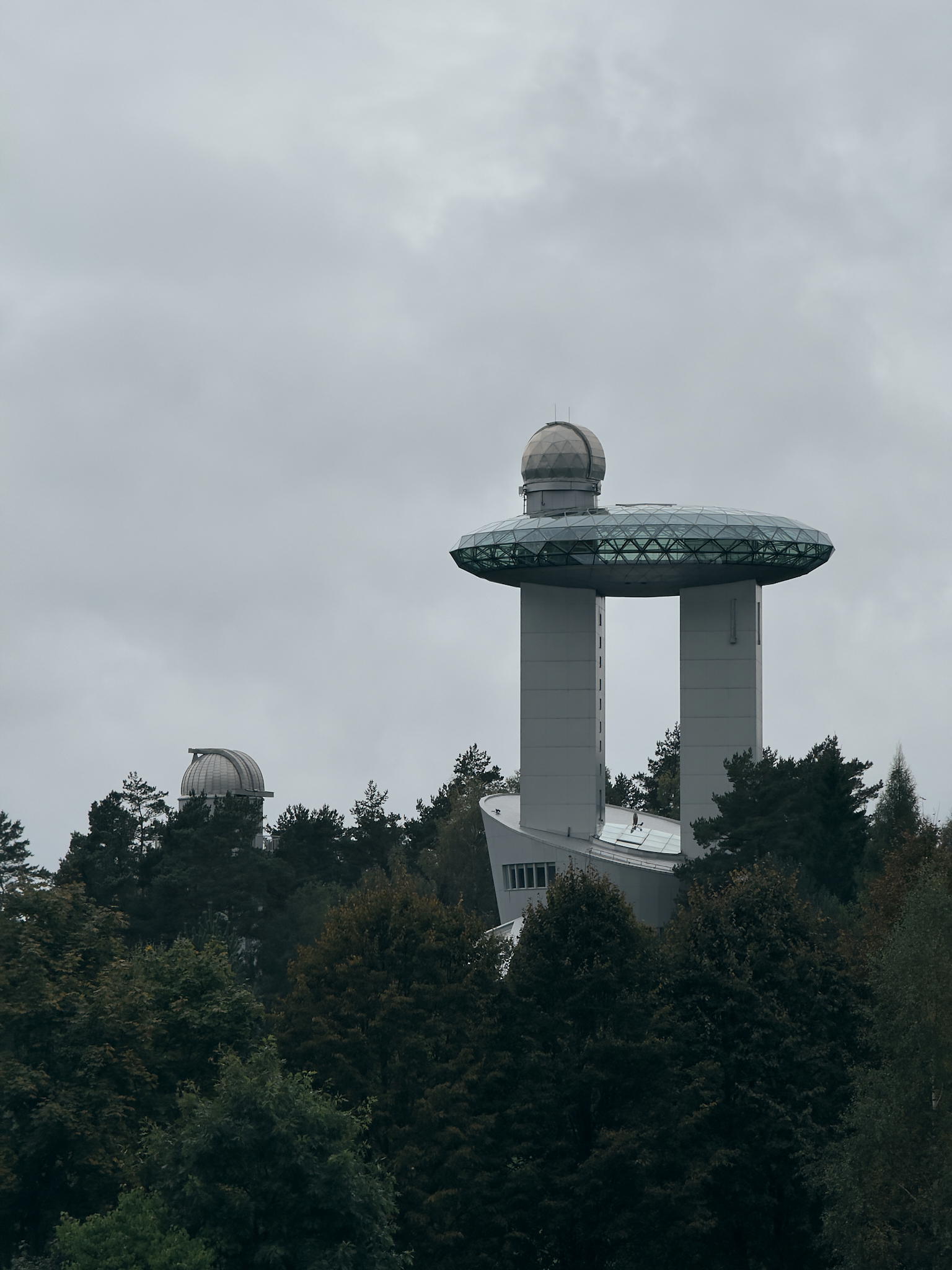
A UFO in the middle of Lithuanian nowhere
Surrounded by forests, hills and lakes, the museum is quite remote. And that makes perfect sense, because anyone who wants to observe stars and distant galaxies can do without light pollution.
We spotted the futuristic-looking building from afar. It looked a bit as if a UFO had landed in the middle of the Lithuanian forest. And that architecture actually suits the subject quite well.
This isn’t your average astronomy museum. It’s not just about planets, stars and galaxies, but also about how people have been trying to understand the universe for thousands of years.
What did our ancestors see in the stars? How did calendars come about? How does our solar system work? And is there perhaps someone else out there? These are questions humanity has been asking for quite some time, and some of them still have no definitive answers.
The museum combines modern astronomy with ancient myths, cultural beliefs and the history of space exploration. Quite an interesting mix.
We were very curious and marched straight to the entrance, full of enthusiasm.
Lithuanian or Russian? Er… neither!
Inside, a friendly lady explained that the museum could only be visited as part of a guided tour.
Oh, I see.
We obviously hadn’t known that beforehand.
Had the whole drive been for nothing?
But it got better.
Today, there were only tours in Russian or Lithuanian.
“Great.”
We speak neither Russian nor Lithuanian. And a few friendly words like “Labas” and “Ačiū” probably won’t get you very far on a tour about astrophysics.
The lady did have a solution, though: at 3:30 pm there would be one more Lithuanian tour with two spaces still available.
In addition, we could download an app that would give us English explanations and videos via QR code in every exhibition room.
Well, then! That sounded like a plan.
However, we had arrived at 2 pm, which left us an hour and a half until the tour. Plenty of time to explore the outdoor area.
Stonehenge, Lithuanian style?
There’s plenty to discover outside, too. Among other things, there are various planet models, a sundial and a rather large arrangement of stones. We had no trouble identifying the planets. But the stones?
What was that supposed to be?
A Lithuanian Stonehenge? A prehistoric meeting place? Or had someone simply arranged a few stones particularly neatly?
We wandered around a bit and looked at the structure, but weren’t really any the wiser at first.
It turns out to be the so-called “Lithuanian Sun”, a stone circle about 30 metres across, whose stones come from different regions of Lithuania. It is designed so that the cardinal directions, as well as the solstices and equinoxes, can be read from it. Quite clever!
If you know what you’re looking at, that is.
The whole construction only made sense to us later, when we could see it from above. Until then, it remained Stonehenge, Lithuanian edition.
A crash course in astronomy, in Lithuanian
Our tour began at 3:30 pm sharp.
A gentleman welcomed the group and led us through the various exhibition rooms.
He apparently told us a great deal about our solar system, gravity, the history of astronomy and the instruments people used in the past to try to unlock the secrets of the universe. At least, that’s what we assume.
Because what we understood was…
Absolutely. Nothing.
Our guide spoke Lithuanian, after all. And at a speed that would probably have left even native speakers gasping for air now and then.
So we stood there, nodding with interest every now and then and trying to pick out anything familiar from the torrent of words.
“Galileo!”
Ah! We know him!
“Copernicus!”
Yes! Heard of him!
At least two names we could identify without a doubt.
The rest was about as comprehensible to us as a message from a distant galaxy.
But we had our app.
So we dutifully scanned the QR code in every room, watched the English videos and read the explanations on our phones.
And it was genuinely interesting. The exhibition leads you through different areas of astronomy and space exploration, from the first attempts to interpret the night sky, through the development of astronomical instruments, to modern satellites and the search for extraterrestrial life.
There are meteorites, historical objects, models and loads of fascinating information on just how tiny our Earth is compared with the rest of the universe.
It makes you feel rather insignificant as a human being.
On the other hand, we did manage to download an app and scan QR codes. So humanity isn’t completely hopeless after all.
Two tours at once, one of them on your phone
Interesting as the exhibition was, it got a bit tiring at times.
Imagine standing in a room full of fascinating objects that you’d love to take a closer look at straight away.
At the same time, the guide is enthusiastically telling you something in Lithuanian at breakneck speed.
And you?
You stand to one side, staring at your phone and trying to watch the English explainer videos.
By then, the guide has long since moved on to the next topic. It felt a bit as if we were doing two tours at once: one live, of which we understood nothing, and one digital, where we constantly had to make sure we didn’t lose the thread. Still, it was a good solution. Without the app, we would probably have come out knowing far less about astronomy and with a much bigger question mark on our faces.
Ten floors up to the stars
To finish, we headed up to the viewing platform, about 32 metres above the ground.
By the stairs, of course.
Ten floors.
We were apparently of the opinion that you could manage those at a sporty pace, too.
When we reached the top, our first thought was therefore not of the stars, the universe or the impressive architecture.
But simply:
Air! We need air!
Once we were breathing more or less normally again, we enjoyed the view.
From up here, you look out over the vast forests and lakes of the surrounding area. A beautiful landscape, even under a grey sky.
The observatory with its telescope is also up here. Under the right conditions, it is used to observe stars and other celestial bodies at night.
For us, though, it was just the view over the landscape. In daylight and under our cloud-covered sky, stargazing was out of the question anyway.
But there was one more little aha moment.
From up here, we could finally make out the stone formation outside properly.
Oh, look!
A sun!
With sunrays!
There we go. The mystery of our supposed Lithuanian Stonehenge was solved, too.
Every now and then, you simply need a bit of distance to understand things.
In our case, 32 metres of elevation.