
🇱🇻 Riga & Jūrmala
Every now and then, we have to throw our travel plans out of the window. Especially when the weather decides to make a bit of a drama out of things.
After our visit to Irbene, we’d planned to head to Cape Kolka, at the northern tip of Latvia’s Courland Peninsula, where the Baltic Sea meets the Gulf of Riga.
But our tour guide casually mentioned that a storm warning was coming into effect the following day. Oh, lovely.
Our planned overnight spot was right on the coast, and most of the drive would have taken us through forest. Not exactly the best combination in a storm. We weren’t particularly keen on dodging falling trees. So, change of plans.
Instead of a peaceful spot by the sea, we headed straight for Riga, Latvia’s capital.
After spending so much time surrounded by nature, arriving in a big city felt a little overwhelming at first. Cars, trams, people and something happening everywhere you looked. But Riga soon won us over.
We found an official campervan parking area right next to what looked like an abandoned office building. Not exactly the most romantic setting, but the location was brilliant. All we had to do was cross a bridge over the River Daugava and we were practically in the beautiful Old Town.
The toilet and shower facilities, however, took a little getting used to. They were inside the aforementioned building, which meant walking through deserted corridors just to have a shower.
A bit like exploring an abandoned building.
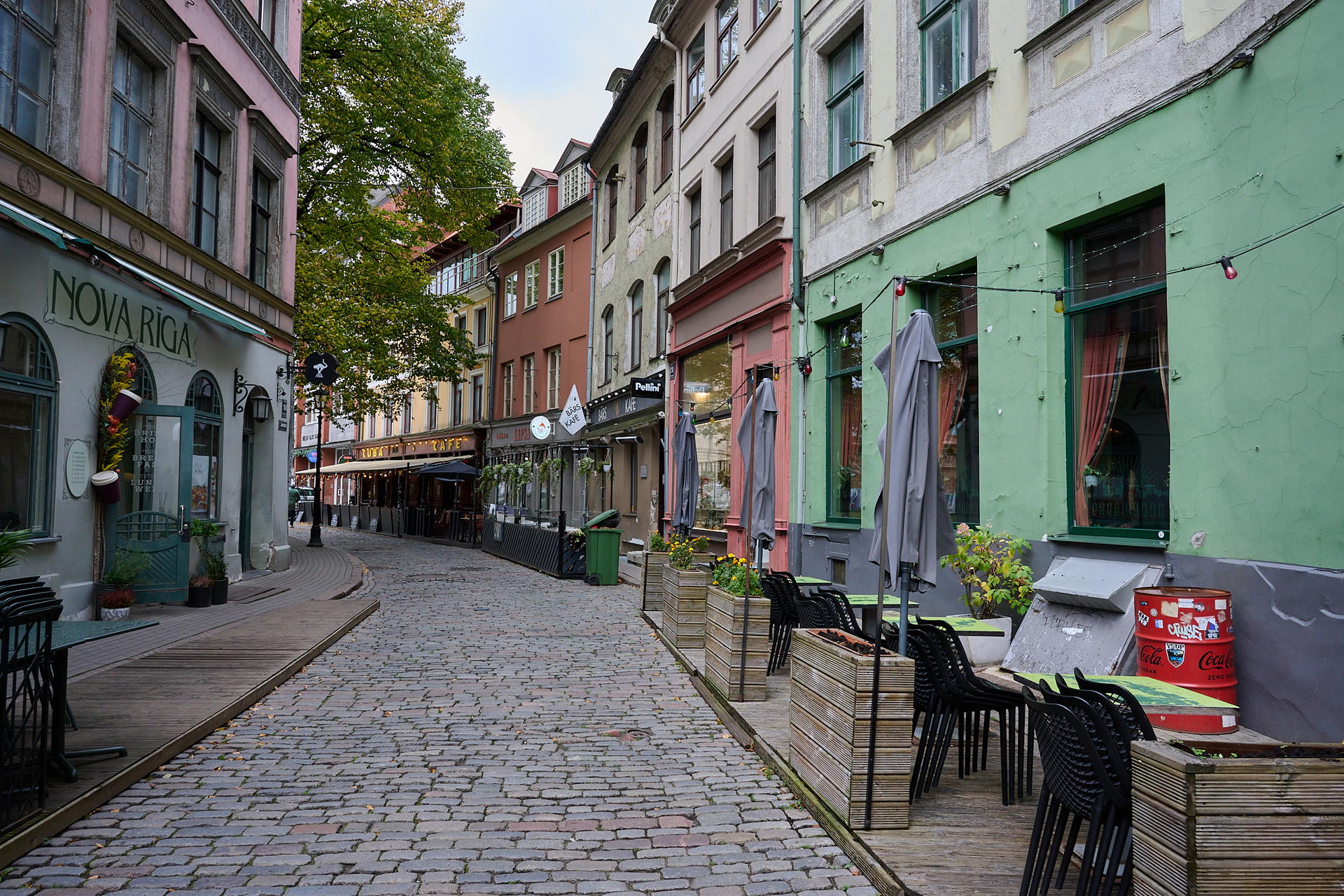
Riga was founded in 1201, was once an important Hanseatic trading city and is now the largest city in the Baltic states. Its historic centre has been a UNESCO World Heritage Site since 1997.
And quite rightly so!
One of the most impressive buildings is the magnificent House of the Black Heads on Town Hall Square. With its elaborate decorations and ornate façade, it looks a bit like an enormous gingerbread house.
Originally, it served as a meeting place for a brotherhood of unmarried merchants. It was destroyed during the Second World War and eventually rebuilt in the late 1990s.
And then, completely unexpectedly, we came across some familiar faces.The Bremen Town Musicians!
There they were, right in the middle of Riga: a donkey, dog, cat and rooster, all stacked on top of one another, just like in the famous Brothers Grimm fairy tale.
The sculpture was a gift from the city of Bremen and even has a political meaning. The animals symbolically peer through the Iron Curtain towards a new world.
Well, you learn something new every day!
Naturally, no proper city stroll is complete without a coffee and cake stop.
Right next to the famous Three Brothers, a group of three historic houses, we discovered a rather cute little café.
The coffee was lovely. The velvet cake? Well, let’s just say it didn’t quite live up to expectations. And judging by the number of German tourists inside, our supposedly hidden gem wasn’t quite as secret as we’d thought.
With the cake having been a bit of a disappointment, Stefan decided it was time for something more substantial.
And since preparing proper Belgian chips in Wilma isn’t exactly practical, he simply couldn’t walk past a chip shop advertising supposedly hand-cut Belgian fries. His eyes lit up. You could practically see the excitement building.
Unfortunately, the disappointment was just as spectacular.
What arrived was a rather sorry-looking pile of half-cooked, mushy potatoes.
Not even remotely close to proper double-fried Belgian chips!
As far as I’m concerned, that’s a serious violation of international chip law.
The best chips really do come from Belgium.
And thank goodness I hadn’t ordered any.
From Zeppelins to Art Nouveau
Another highlight was Riga Central Market. The market is housed in five enormous halls built using parts of former German Zeppelin hangars.
Where airships were once meant to be housed, it’s now all about food. Fruit, vegetables, fish, meat, cheese, baked goods and all sorts of Latvian specialities. There’s plenty to see, smell and, of course, taste.
And naturally, there was an elderly lady selling individual Haribo Goldbears for five cents each, carefully picked out of their original packets. Because why wouldn’t there be?
Unfortunately, only two of the five halls were open during our visit, but even so, it was a pretty impressive place.
Afterwards, we carried on exploring the city, including the famous Alberta iela.
Riga is renowned for its Art Nouveau architecture, and the architects responsible for this street clearly had a wonderful time letting their imaginations run wild.
Elaborate façades, ornate balconies, floral decorations, faces and all sorts of unusual figures adorn the buildings.
For Stefan, it was quite a photographic challenge trying to fit all that architectural detail into a decent shot.
There was certainly no shortage of things to photograph!
The following day, we fancied exploring a different part of the city and headed to Āgenskalns Market, on the other side of the Daugava.
The historic market hall dates back to the late 19th century and reopened in 2022 after an extensive renovation.
Today, it combines a traditional market with modern food stalls, independent shops and creative little businesses.
A really cool place to have a wander and a browse. And, of course, I found something. A lovely top that you certainly wouldn’t find in your average high-street shop.
A successful bit of sightseeing, I’d say!
After Riga, we were ready for the coast again.
Our next destination was Jūrmala, a popular seaside resort west of the capital, known for its long sandy beaches, pine forests and beautiful old wooden villas.
Before heading to the beach, though, we went for a walk through the Ķemeri National Park.
We followed narrow wooden boardwalks through a landscape that looked almost otherworldly in the rather gloomy weather.
The misty atmosphere, muted colours and eerie stillness gave the place a strangely magical feel.
Afterwards, we headed to the coast, where we found a lovely spot to park Wilma right by the sea. And then something happened that we really hadn’t expected after the weather we’d had recently.
There wasn’t a breath of wind.
The sea was completely flat, almost like a mirror.
Not a wave in sight.
We absolutely loved being able to wander along the beach whenever we fancied it. First thing in the morning, in the evening or just because we felt like it.
Miles of sandy beach, perfectly calm water and hardly another soul around.
After the hustle and bustle of Riga, it was exactly what we needed.