
🇱🇹 The Hill of Crosses – A hill that refuses to give up
What do you do with an old bicycle or a worn-out pair of skis? Take them to the tip? Sell them at a car boot sale?
Well, in Lithuania, there seems to be a third option: turn them into a cross and stick them on a hill.
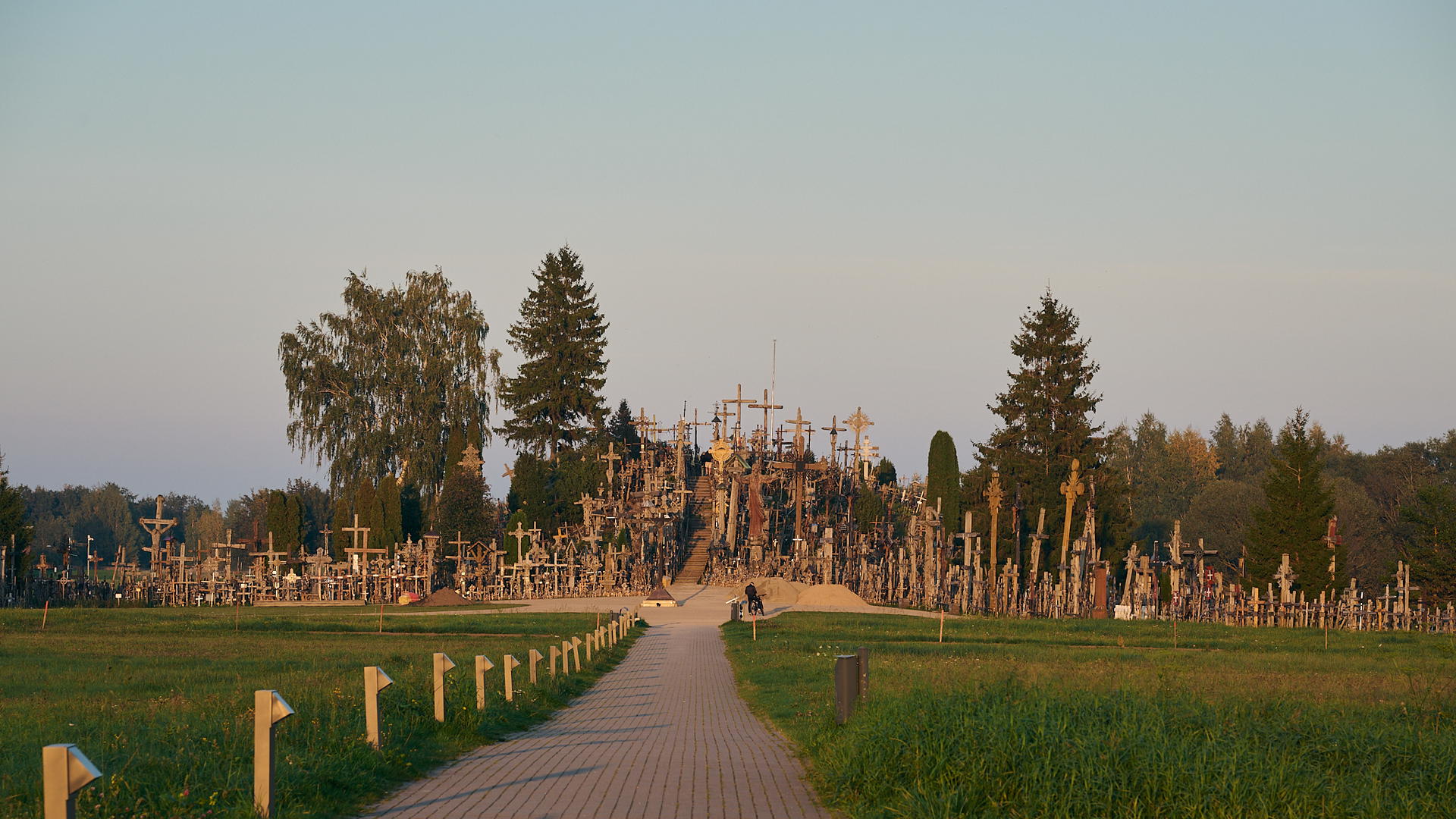
Welcome to the Hill of Crosses (Kryžių kalnas), where an estimated 200,000 crosses now stand. Big ones, small ones, colourful ones, simple ones, made of wood, metal and even things you wouldn’t normally associate with religious symbols.
In between, countless rosaries hang like garlands from the wooden beams, alongside statues of saints and personal keepsakes. It’s a wonderfully chaotic collection that looks almost overwhelming at first, but becomes more and more fascinating the closer you look.
And all of this is crammed onto a hill that’s barely ten metres high.
What initially looks like a rather extraordinary collection of religious objects actually has a history that left quite an impression on us. But more on that later.
We visited the Hill of Crosses after work, just before sunset. The light was beautiful, bathing the countless crosses in a warm, golden glow.
Normally, this famous pilgrimage site attracts visitors from all over the world and can get pretty busy. Luckily for us, there was hardly anyone around, so we could wander peacefully along the narrow paths between the crosses.
Many of them carry names, personal messages or little notes of thanks. People leave them here to pray, remember loved ones or express gratitude.
There’s so much to take in that you hardly know where to look first. And behind every cross, there’s a personal story.
A portable radio instead of heavenly silence
There was just one thing that didn’t quite fit the otherwise special atmosphere.
Somewhere nearby, someone had apparently placed an old portable radio.
And from this little radio came a rather loud Lithuanian voice.
We assumed it was broadcasting prayers or some sort of religious sermon. Needless to say, we didn’t understand a word.
Was this the usual soundtrack to the pilgrimage site? Or had someone simply decided that a bit of background entertainment wouldn’t go amiss?
No idea.
We’d rather expected a quiet, peaceful place for reflection.
Instead, we got Lithuanian prayer radio at full blast.
Oh well. Everyone has their own idea of what heavenly atmosphere should sound like.
A symbol of resistance
What really makes the Hill of Crosses special, though, is its history.
The first crosses are thought to have appeared here in the 19th century, partly to commemorate those who lost their lives during uprisings against Russian rule.
During the Soviet occupation, the hill became a powerful symbol of faith and resistance.
The Soviet authorities were far from impressed. On several occasions, they ordered the crosses to be removed and the hill to be bulldozed.
Major destruction took place in 1961, 1973 and 1975.
But the people refused to be intimidated.
They simply came back and put up new crosses, sometimes secretly under cover of darkness, despite the personal risks involved.
The authorities cleared the hill. The people rebuilt it. Again and again.
In 1993, even Pope John Paul II visited the Hill of Crosses, which by then had become one of Lithuania’s most important pilgrimage sites.
And to this day, new crosses continue to appear.
Much more than just a hill full of crosses
We’re not particularly religious ourselves, but this place genuinely moved us.
Not so much because of the crosses themselves, but because of what they represent.
People who refused, and still refuse, to let others take away their faith, hope and identity. People who kept coming back, despite bans, destruction and intimidation.
When you consider Lithuania’s history and the current political situation, the significance of this place becomes even more powerful.
The Hill of Crosses isn’t just a religious attraction. It’s a remarkable reminder that peaceful resistance can make a difference.
And that people don’t always have to accept whatever is forced upon them!
What stayed with us most was the message behind this extraordinary place: You can destroy the crosses, but you can’t so easily break the spirit of the people who keep putting them back.
And that’s a message that feels just as important today.
Because, at the end of the day, we’d all like to believe that good will eventually prevail!