
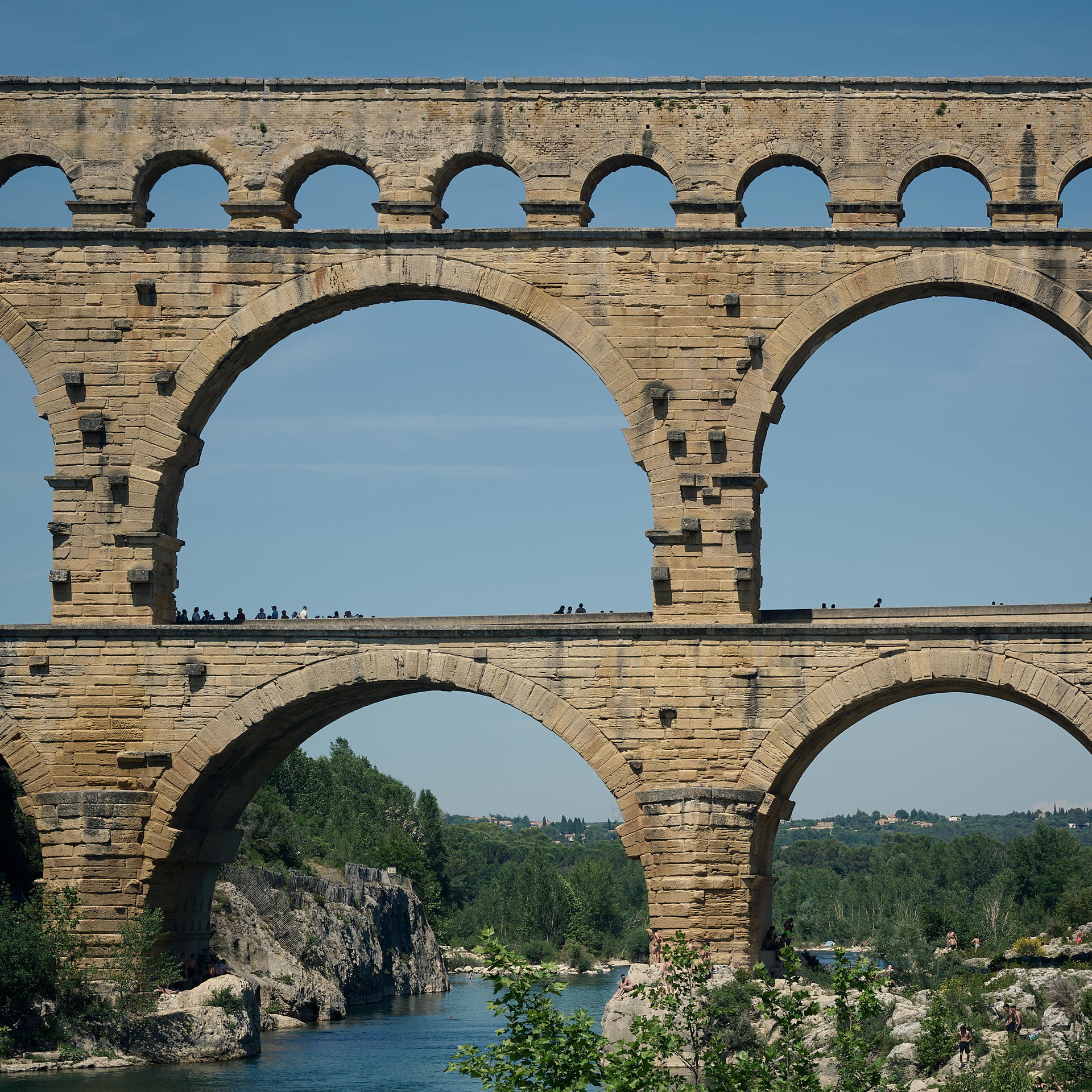
🇫🇷 Pont du Gard
One evening, while enjoying a really tasty local pale ale and an eau du pompe (yes, I am absolutely trying to sell you tap water as something fancy 🍸🚰), we asked the waitress for advice on what we absolutely shouldn’t miss in the area.
She happily rattled off a list of recommendations:
- Avignon (doh!) – check ✅
- L’Isle-sur-la-Sorgue – check ✅
- Orange – check ✅
- Pont du Gard
We quickly realised that item number four had already been on our list. We simply hadn’t paid much attention to it because it looked much further away on the map than it actually was.
As it turns out, it’s only about a 30-minute drive away. Entry to the aqueduct is free and parking costs just €9 for the entire day.
To top it off, she told us it’s also a fantastic swimming spot. The only warning was that it would probably be quite busy due to the combination of weekend and 38°C weather.
The next day we drove to Pont du Gard, parked Wilma and started making our way towards the historic landmark.
We were completely unprepared for what awaited us.
One moment you’re walking through a pleasant little park and the next you’re standing in front of this absolutely colossal monument.
It’s difficult to put into words what it feels like to stand beside a structure that was built almost 2,000 years ago and still looks younger than many buildings constructed back home in the last few decades.
A few facts for those who are interested.
(Which I hope is all of you, otherwise I’m putting in a lot of effort here for nothing 🤪)
- Originally thought to have been built around 19 BC, experts now date its construction to somewhere between 40 and 60 AD.
- Construction took only three to five years. That may sound like a long time, but remember the era and the tools available.
- It’s estimated that around 1,000 people worked on the project.
- At roughly 50 metres above the River Gardon, it is the tallest surviving Roman aqueduct bridge.
- The remaining structure is about 275 metres long, although it originally measured around 360 metres.
- It consists of three levels and 52 arches (counting those that still stand today).
- Around 50,000 tonnes of limestone were used during construction.
- Estimates suggest it carried roughly 20 million litres of water per day, or 20,000 m³. Some estimates are even higher.
The most impressive engineering achievement, however, is probably this:
As part of a 50-kilometre-long waterway, the total drop in elevation was only 17 metres – or 0,034 %!
Seventeen.
Across fifty kilometres.
And it worked.
As I said, it’s incredibly difficult to describe what it feels like to stand next to such an impressive piece of engineering.
We’re simply grateful that we had the chance to experience it first-hand.
If you ever find yourself in the region, it is absolutely a must-see.
… Oh, and as for the swimming part — yeah, it was way too busy!