We’re retrofitting insulation to our water pipes!
Introduction
After discovering the weak points of our Pössl Summit Prime 640 in Norway – the water pipes that partially run directly along the metal exterior of the FIAT Ducato – we decided to fix this ourselves. With the help of a friend and my employer's support in the form of a workshop where we could do the work, we retrofitted insulation to all critical water pipes in 2 days.
Background
We want to travel with our camper in winter too, as we simply love the cold and snow. Unfortunately, through the Pössl forum and by investigating our own vehicle, we discovered that Pössl takes some shortcuts with the water infrastructure that would definitely lead to frozen pipes at temperatures below 0°C:
Behind the kitchenette, the water pipes run directly along the outer shell of the base vehicle and are completely uninsulated.
The same situation exists partially on the driver's side in the area of the toilet cassette compartment.
So it was clear to us that we could only travel in winter with an empty tank. In some countries like Norway, this isn't a problem – there are clean, warm, and affordable showers on almost every corner. In other countries, unfortunately, that's not the case.
Plus, you don't want to have to plan your showers so inconveniently…
The Assessment
Equipped with an inspection camera/borescope, we identified the critical spots.
What we discovered was quite shocking in places.
We ordered the "Winter Package" with our Pössl Summit Prime 640. This consists of an insulation mat for the rear doors, a heater for the waste water tank (but without insulating it!!) and an additional warm air duct to the kitchenette, which is supposed to prevent the pipes in the kitchen from freezing.
As you can clearly see in the pictures, this package is frankly a rip-off.
We really hope that in our case the installer simply didn't feel like doing a proper job, because if the installation was done "according to plan", then you can only call it deception/fraud.
The warm air duct has to switch sides under the shaft cover because the cutouts in the boards on the left and right aren't parallel. Since the shaft cover is quite low, the duct was simply stepped on and flattened.
Behind the kitchen, it gets even worse – the duct is completely crushed. It can't transport any air at all.
Honestly, we were totally surprised when we saw the duct with the camera. Until that point, I had assumed that the duct was no longer part of the winter package, since the kitchenette was always freezing cold.
Well, that explains it.
Furthermore, the duct ended behind the wooden paneling between the kitchen and the outer wall of the vehicle. What this is supposed to achieve still escapes us to this day, because any heat dissipates immediately there and doesn't reach the pipes at all.
The Planning
Fortunately, I work for a digitalization service provider that also handles IT administration for a large building technology company and has offices in the same building.
So we quickly found plenty of experts to advise us.
We considered various solutions – from "everything new" to "just risk it"….
… the options:
- Build a water circulation system, because water in motion doesn't freeze or at least not as quickly. The idea: install a circulation pump that uses little power and keeps the water constantly moving. Unfortunately not practical, as it would have meant completely new infrastructure.
- Install pipe trace heating (heating cable). This is essentially just a cable that acts as a resistor and thus heats up. The cable is wrapped around the pipes and keeps them comfortably warm. The problem: power consumption. For 12V systems, we found very little, and the options started at 15W per meter. With pipe lengths of ~16m, the heat would quickly run out even with our large battery. Of course, you wouldn't have to heat all sections, but consumption remained a problem.
Also, 230V seemed like the better alternative, but we don't have an inverter and don't really want to retrofit one. - Armaflex! Wrap all pipes in thick Armaflex. This seemed like the simplest option that still has a big effect. Combined with different pipe routing to avoid the outer wall.
- Replace all hose lines with more professional, pre-insulated lines. Quite tempting, but the effort seemed higher than #3, as we would need to access even more places and dismantle even more furniture for a complete replacement.
- Leave everything as it is and continue traveling as before.
We decided on #3 and got the materials.
The Installation
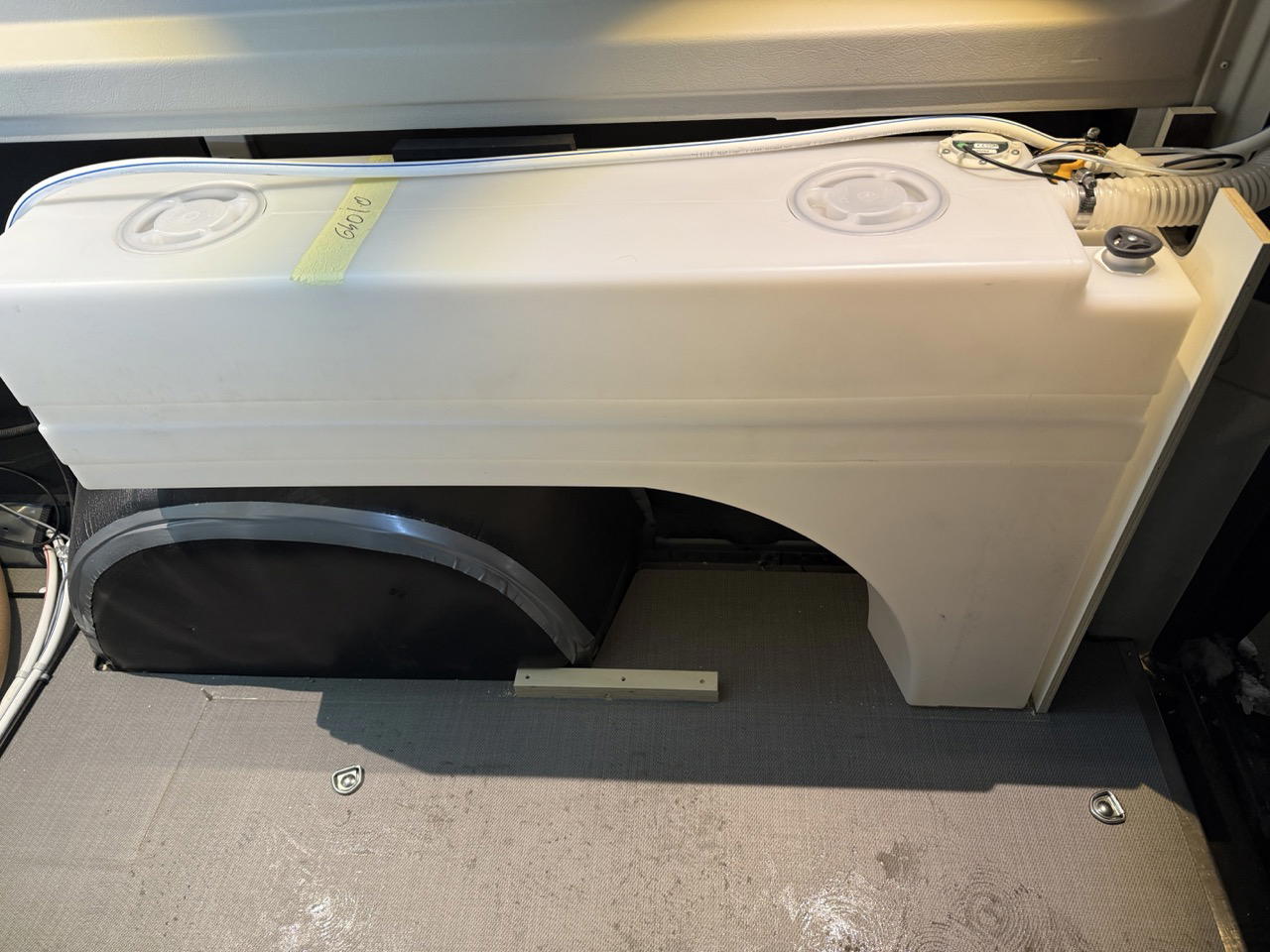
First, we removed the furniture on the right side. The water tank cover and the cabinet next to the kitchen.
After brief consultation, we decided to completely remove the old pipes and re-route them. Instead of routing them awkwardly behind the kitchen, simply go straight up at the first kitchen cabinet and through the back wall at the top directly to the faucet.
This not only shortens the pipe run but also allows us to stay completely away from the vehicle's outer shell.
We rerouted the warm air duct so that it now blows warm air under the water tank. With a lot of effort, we managed to save the duct, so we didn't have to buy a new one.
We also enlarged the cutouts for the shaft so that the warm air duct can now run neatly parallel to the pipes without having to cross over them. This way it could fit into the covers in its "normal shape" without being stepped on and flattened.
The driver's side was easier to change. We didn't have to remove any furniture since we could access all the pipes from the toilet cassette compartment and from the bench seat.
The only challenge was loosening the hose clamps, but patience does the trick. Pro-tip if you want to do something similar: Start at the boiler, disconnect all pipes and pull them through to the toilet cassette compartment. Then you can easily access everything.
Conclusion
Overall, the retrofit was really easy, you can access all areas well, and it's absolutely worthwhile.
What we really don't understand, however, is how Pössl gets away with this and delivers vehicles in this state. If these steps were done at the factory, it would probably mean little extra effort, but customers would be much happier.
Shame on you Pössl – saving money at the wrong end.
THANK YOU 🤩
A huge thank you goes to Leon from L2 Print Factory, who helped us with the conversion from the beginning and went all-in. Absolutely amazing and what a legend! It was so much fun to complete this project with you.
Feel free to check out Lea & Leon's shop, there are lots of cool things to buy 👍